Wednesday, February 29, 2012

Symmetric Logic of the ‘Unconscious’ Right Brain


Unconscious thought operates with a systematic logical structure of its own.
In other words, it has its own internal logic — which is different from the
logic used by consciousness. It uses symmetric logic, according to Blanco.6
Using this logic, the ordinary concepts of cause and effect; time and space
are over-turned. We are confronted with an absence of mutual contradic-
tion and negation; and timelessness.
According to Jehning, psychoanalysts have tended to focus on vari-
ous detail aspects of Freud’s work while disregarding the fundamental and
disturbing implications of the idea that the mind (in this context, the con-
scious left brain) works within a framework of timelessness and spaceless-
ness (i.e. within the environment of the intuitive right brain and the ‘uni-
versal mind’).
Unconscious thinking unites or unifies things which for ‘ordinary
thinking’ are distinct and separated. Relations within the unconscious are
symmetrical, for instance: ‘Mary is different from Clara,’ or ‘A is identical to
B’; they remain true when they are inverted. To use mathematical terminol-
ogy, they are ‘commutative.’
The ‘unconscious’ is characterised by an increasing prevalence of sym-
metry. At the ‘surface’ there is a mixture of asymmetric and symmetric
logic (i.e. both commutative and non-commutative operations apply) but
the ‘deeper’ you go into the unconscious, the more symmetrical it becomes.
Blanco distinguished different ‘strata’ in the mind — the ‘deeper’ the uncon-
scious, the higher the degree of symmetry.
Blanco also noted that the ‘unconscious’ was timeless, placeless, uses
symbols and imagery, appositional, unable to distinguish between hard and
fluid reality (or fantasy) and between the part and the whole; and uses a
combination of symmetric and asymmetric logic.7 It will be immediately
noticed that all the attributes of the unconscious described by Blanco are
identical to the characteristics of the right brain noted in various experi-
ments cited previously.

Divided and Indivisible Realities


Matte Blanco, a renowned psychologist, describes two antagonizing modes
of being: a dividing one (the splitting and polarizing logic of our discrimi-
nating consciousness) and an indivisible one (reality as it is, prior to any di-
vision by discriminating consciousness). According to Def Jehning, Freud’s
‘true psychic reality’ comes pretty close to what Blanco would describe as
our ‘second mode of being’ — what he calls ‘Indivisible Reality.’

Tuesday, February 28, 2012

The Intuitive Mind’s Perception


According to the Surangama Sutra, physical sense perception is by its very
nature limited. It says that the objective world arises from the mind itself.
Taking these manifestations of the mind as being real we go on discriminat-
ing them and cherishing the dualism of ‘this’ (i.e. an attribute) and ‘that’ (i.e.
its complementary attribute). The multiplicity of objects, however, has no
reality in itself and is like a dream. It is not until discrimination is gotten rid
of that the fact that ‘all things are empty, unborn and without independent
existence’ can be appreciated. In ignorance things are perceived and in per-
fect knowledge they are not perceived, the Sutra says. Objects and the world
neither exist nor do not exist — it depends on your frame of reference.
Over time, the Sutra says, sentient beings have been led astray by mis-
taking the nature of their mind to be the same as the nature of any other
object. Their minds became bewildered by outer objects and the perception
of their sight changed to conform to the dimensions of its visual field and
to become limited strictly according to outer conditions. If you learn to see
things by your true mind, says this Sutra, so perfectly universalized will
your mind become that ‘even at the point of a single hair all the kingdoms
of the universe will be seen.’ 5
We must be careful to distinguish between the perception of our eyes
and the intrinsic perception of sight by our enlightened mind that is con-
scious of the fallible perception of the eyes. Though there may be all degrees
of illumination between brightness and darkness, intrinsic perception possess-
es no differentials (in other words no complementary pairs of attributes are
discerned). According to the Surangama Sutra, as soon as consciousness (i.e
divergent awareness) appears, then all such phenomena as sight, space, mo-
tion etc., will be manifested; and as soon as this consciousness disappears,
all such phenomena also disappear. This discriminating consciousness has
‘no originality of its own,’ in other words it is derivative; it is an illusive
manifestation developed by our sensory systems.


Monday, February 27, 2012

Intuitive versus Discriminating (Rational) Mind


The intuitive mind is a sacred gift and the rational mind is
a faithful servant. We have created a society that honors the
servant and has forgotten the gift.

Albert Einstein 

We are now used to hearing about ‘right brain’ and ‘left brain’ processes.
However, before the localisation or lateralisation of certain brain processes
were discovered, there were many references, in philosophy, religion and
psychology, to the intuitive mind versus the rational, analytical or discrimi-
nating mind.
The Lankavatara Sutra, an age-old Mahayanist scripture, speaks of a
‘discriminating mind’ and an ‘intuitive mind,’ which have unmistakable
similarities to the attributes given to the left and right brains, respectively.
According to this Sutra, it is because of the discriminating mind (which
is also called the thinking or intellectual mind) that an objective world
evolves. The discriminating mind is portrayed as a dancer and a magician
with the objective world as his stage. The intuitive mind, however, is the
wise jester who travels with the magician and reflects upon his emptiness
and transience — an observer.

The intuitive mind (now associated with the non-dominant right brain) par-
takes of the universality of a ‘universal mind’ and is one with this universal
(non-local) mind by reason of its participation in ‘transcendental intelli-
gence’ and at the same time is one with the mind-system (the local mind) by
its comprehension of differentiated knowledge (generated by the discrimi-
nating mind). 2
This is consistent with the statement by Def Jehning that the uncon-
scious (which comprises the intuitive and universal mind) is the larger
sphere, which includes within it the smaller sphere of the conscious (the
discriminating mind) because everything conscious has an unconscious
preliminary stage. The intuitive mind sits between the universal mind and
the individual’s discriminating mind.
According to this Sutra, the universal mind transcends all individu-
ation and limits; and is devoid of personality. It is like a great ocean, its
surface ruffled by waves and surges caused by the activities of the discrimi-
nating mind. The discriminating mind has been accused of ‘defiling’ the
face of universal mind — forcing the universal mind to play a variety of parts
as actors. Consequentially, the universal mind has become the storage and
clearing house of all the accumulated mental products and actions of the
various actors. Nirvana, according to this Sutra, is achieved by ‘getting rid
of the discriminating mind.’ However, the cessation of the discriminating
mind cannot take place until there has been a ‘turning-about’ in the deep-
est seat of consciousness. 3 Does this allude to a turning about from the left
brain to the right brain?
The Surangama Sutra, another age-old Mahayanist scripture, describes
something similar — it identifies both a ‘thinking mind’ and an ‘intuitive
mind.’ According to this Sutra, enlightened persons discard the use of their
thinking minds. Even then, they are perfectly intelligent because they ap-
prehend knowledge, ‘not by means of their thinking minds, but directly by

intuition.’ The intuitive mind, according to this Sutra, is not enlightened by
something else; it is ‘self-enlightening.’ The true essence of our conscious-
ness is our ‘enlightened intuition.’ This wonderful intuition, the Sutra says,
abides in tranquility permeating everywhere throughout the phenomenal worlds
and universes.4 In other words, the intuitive mind is non-local (as it expands
into the ‘universal mind’). It is with the ‘attainment of the essential intuitive
mind’ that the intuitive mind’s enlightening nature is known.
Hence, you need to experience the workings of the intuitive mind to
know of its mysterious intelligence because unlike analytical thinking the
thought processes cannot be traced — it (i.e. the right brain) is perceived
as unconscious or a ‘black box’ by the thinking mind (normally associated
with the dominant left brain).

Sunday, February 26, 2012

Gender Differences


Researchers at the University of Pennsylvania Medical Centre have recent-
ly reported that, relative to cranial volume, women’s brains have a higher
proportion of gray matter (which facilitates computations) while men have
a higher proportion of white matter (which facilitates communication be-
tween groups of cells in different areas of the brain). Studies also show that
women have a thicker corpus callosum, which is composed of white matter,
connecting the right and left brains, allowing them to integrate their right
and left brains better. The corpus callosum, however, is composed of white
matter. Women are therefore superior in their capacity to communicate be-
tween the different modes of perceiving and relating to the world, according
to Kristine Hoeldtke.27

Left-Handed People


The brain organization of left-handed people is often different from that of
right-handed people. This could include a reversed brain organisation or
both brains with both language and spatial abilities. For optimal function-
ing, Ornstein believes that the two major functions of the human mental
system need to stay within the range of equilibrium.25 According to him,
the right brain specializations develop to their fullest when informed by
a fully developed left side. Otherwise we get ‘form without content.’ Both
sides of the brain most likely incorporate the other side into their models of
the world. The left side may model the right as part of its own organisation.
The right side may perceive the left side as partially exterior to the organ-
ism, a complicated region of the environment whose rules the right side will
attempt to acquire. The body and possibly the other side of the brain are
experienced as being the exterior environment and subsequently modeled
as such in the right brain.

Saturday, February 25, 2012

Shared Resources and Services


In the 1980s Jeffrey Holtzman of Cornell University Medical College found
that each hemisphere is able to direct spatial attention not only to its own
sensory sphere but also to certain points in the sensory sphere of the oppo-
site, disconnected hemisphere.24 In other words, certain resources in the left
brain are freely available to the right brain and vice versa. The two brains
therefore use the other brain for certain parts of the processes that are initi-
ated and concluded in the other brain. Co-operative processing and sharing
of resources must be borne in mind when talking about the dichotomy of
tasks between the right and left brains.

Migration of Skills from Right to Left Brain over Time


It has been noted that while novel skills, such as playing a musical instru-
ment for the first time, may be handled by the right brain, the skills and
knowledge tend to migrate to the left brain over time — thus, inhibiting
the creativity initially exhibited — this may also be the basis of ‘beginners’
luck.’
 
PS: Sorry for the short post .

Plasticity of the Brain


The brain is fairly plastic and can accommodate different types of process-
ing if it was organised differently physically — for example if there was sig-
nificant damage to one hemisphere of the brain. One of Michael Gazzaniga’s
patients developed the capacity to speak out of the right brain 13 years after
the brain surgery. There are also cases involving children, where one cere-
bral hemisphere was removed. Children who have undergone brain removal
at an early age develop more or less normally. The remaining cortex takes
over the functions once provided by the removed cortex. If the removal oc-
curs later in life, however, this sort of compensation does not occur.

Friday, February 24, 2012

Unsuspected Connections and Disconnections


Until recently it was believed that the entire corpus callosum must be sev-
ered to provide relief from severe epileptic seizures. However this is not
necessarily the case — the corpus callosum only needs to be severed enough
to provide relief, without losing all neural integration. Based on this new
form of surgery, Dr H G Gordon, a neurobiologist at the California Institute
of Technology, also found that a connection at the back of the brain alone
is enough to integrate both human minds. According to him, ‘the cerebral
hemispheres totally integrate if but a small fraction of the corpus callosum
remains intact.’
On the other hand, tumors or blood clots pressing on only part of an
intact corpus callosum can cause full-blown Jekyll/Hyde reactions (similar
to split-brain patients). Gordon and his co-workers J E Bogen and Roger
Sperry believe that tumors and clots cause waves of inhibition to spread to
all parts of the corpus callosum. The shocked nerve fibers simply do not
carry impulses from one side of the brain to the other. Furthermore, it has
also been found that even in a healthy corpus callosum only certain types
of information can be carried. Complicated higher level information cannot
pass through from one brain to the other.
Split-brains can be initiated both physically and chemically. It may also
be initiated psychologically through thought processes and communica-
tions between the left and right brain selves — resulting in one side being
dominant. Logically, this could mean that a normal person with a dominant
left brain may exhibit behavior similar to a split brain person with a partially
damaged right brain.

Avoiding Generalizations


The physical boundaries of the left and right brains must not be taken too
seriously. We are ultimately concerned more with the types of processing
that goes on in the brain — whether bottom-up (starting from parts) or top-
down (starting from the whole) rather than their physical locations. The
split-brain experiments show that if the two hemispheres are not connected
into a single circuit — that is, if they do not speak to each other — they ex-
ist essentially as two major circuits. Only the circuit connected to the lan-
guage centre seems to result in conscious awareness. Hence, in split-brain
patients, the right brain functions do not enter into consciousness directly
since it is not connected to the (conscious) left brain. However, it should be
noted that the two brains can speak to each other on another level that does
not require the corpus callosum. They can also speak to each other via the
limbic system (through the thalamus and hypothalamus) and the autonomic
nervous system.

Aging and Brain Dominance


The rates of development between the two brains are different during a per-
son’s lifetime. The right brain develops at a faster rate during the first two
years in humans. Spear has shown that an infant attends to more events in an
episode than even an adult. However, this ability deteriorates as the left brain
develops. From ages 3 to 5, the left hemisphere develops more rapidly, as the
child acquires language.21
The gradual elimination of ‘blissful’ states experienced in childhood
may be due to the development of the discriminatory left brain. The old say-
ing that we have to become like a child to ‘enter the kingdom of heaven’ also
becomes more meaningful with our understanding of brain development.
Many aging studies show a decline in right brain functions as we age.
For example, many researchers report an age-related drop in spatial mem-
ory while no significant analogous changes occur in left brain tasks. Also,
memory for faces, a predominantly right brain ability, declines with normal
aging.22 As we age, the left brain attempts to control all aspects of the or-
ganism, including the flow of information across the corpus callosum. In
other words, the left brain becomes dominant. Klisz found that adults in
their early forties could best be differentiated from adults in their fifties by
impairment tests to their right brains.23
All this suggests that when we (most of us) come into this world we
are right-brain dominant; but when we leave it we are left-brain dominant.
Since the right brain is also associated with creativity, does this provide
evidence on why the most creative work of many artists and scientists are
normally found earlier in life rather than later?

Thursday, February 23, 2012

The Right Brain is Visual and Spatially Intelligent


According to Ornstein, damage to the right brain not only destroys the visual
information coming from the left, but more importantly our understanding
of space. Similarly, damage to the left brain destroys the ability of the right
brain to verbalize occasionally (using the left brain’s speech centres). 20 The
left brain verbalizes and is time-like. In contrast, the right brain communi-
cates using visual messages and is space-like. We can say, therefore, that the
left brain handles ‘name’ and the right brain handles ‘form’; the right brain
handles ‘space’ and the left brain ‘time.’ Together, the whole brain gives us
the experience of ‘name and form’ in spacetime.

Spatial intelligence is that aspect of our intelligence that allows us to make
judgments about the three-dimensional world in which we live. A football
player catching a pass relies on spatial intelligence to judge the trajectory of
the ball. An architect uses it to visualise what a building will look like when
it is completed. We all use it every time we drive a car and have to judge the
distance to the car in front of us. Advanced math courses require good spa-
tial intelligence. This spatial intelligence is related to the ability of the right
brain to see things holistically, using a top-down process. As already noted,
while the left brain may see three lines, the right brain sees a triangle.

Wednesday, February 22, 2012

Right Brain has Convergent Awareness


Karl Popper and Nobel winning neuroscientist John Eccles, authors of ‘The
Self and Its Brain,’ describe the right brain as the ‘minor brain.’ Some have
even questioned whether the right brain is conscious at all. The left side has
long been considered the dominant hemisphere, responsible for the unique-
ly human gift of language and because of this — many have argued — our
self-awareness and intelligence. Eccles thinks that the right hemisphere is
not conscious at all because split-brain patients cannot express the contents
of their right hemispheres in words. This is obviously a premature conclu-
sion. How does consciousness arise?
Consciousness is how we feel the affirmation-negation contrast.
Alfred North Whitehead
The Hindu saint, Paramahansa Yogananda says, ‘There are no pic-
tures without light and shadow.’15 In other words, there is no consciousness
of this or that without discrimination or differentiation. Consciousness or
conscious awareness arises when complementary attributes are differentiat-
ed in the environment — hot from cold, acidic from alkaline, light from dark
and so on. Even single-celled organisms move away from certain stimuli
and move towards other stimuli by differentiating favorable and unfavora-
ble sensations. The nature of conscious awareness is therefore necessarily
dualistic. We will describe this type of consciousness or awareness (associ-
ated frequently with the left brain) as ‘divergent awareness’ in this book (or
conscious awareness.)
A perceptual system, which is neither attracted to an attribute nor re-
pelled by its complementary attribute, does not differentiate hot from cold,
acidic from alkaline, light from dark and so on. This would be the opposite
of being conscious — but we should not conclude that it is ‘unconscious.’
We will describe this type of consciousness as ‘convergent awareness’ (or

jay alfred | brains and realities
unconscious awareness) in this book. The choices for these terms arise
from the different ways in which the two brains relate the self with the
environment.
According to Kaiser, the right brain believes the organism includes the
environment and subsequently models this extended self. The self is inter-
preted from the vantage point of the world and converges into the self from
the environment. The left brain (and lower structures on the left side of the
brain), on the other hand, believes events in the world follow the organism’s
rules of organisation. In other words, the world is interpreted from the van-
tage point of the self and diverges out from the self to the environment. In
other words, the right brain uses exterior rules (from the environment) in its
neuronal organisation and processing; whereas the left brain uses interior
rules (from its self) to perceive and analyse the environment.16
Anatomical evidence supports these inferences. The left brain has a
greater density of cells than the right, and more importantly, there is more
gray matter relative to white, with the opposite pattern in the right brain.17
This suggests that the organisation of the left brain, relative to the right,
emphasises processing within regions while the right brain emphasises
processing across regions. Evidence from both normal and brain-damaged
populations supports this dichotomy, according to Kaiser.18
Divergent awareness is asymmetric. It oscillates from an attribute to
its complementary contrary attribute over time; and is analytical and dis-
criminatory — this is normally associated with the left brain. Convergent
awareness is symmetric and appositional, carrying out parallel process-
ing of dissimilar attributes or synthesizing inputs from two or more serial
processing streams — this is normally associated with the right brain. In
other words, the right and left brains combine convergent awareness with
divergent awareness. This configuration is similar to Bernard Baars’ idea
of a ‘theater (of consciousness)’19 which combines convergent input with
divergent output.

Right Brain is a Parallel Processor and Appositional


Experiments conducted by Bianki concluded that in animals the parallel-
spatial processor of information processing is localised in the right hemi-
sphere and the sequential-temporal processor in the left one.10 According
to Kaiser, ‘Reducing input from the environment to components and se-
quences is a result of the left side’s form of organisation.’11 McCarthy says,
‘The left brain processes in a linear, sequential, logical manner. When you
process on the left side, you use information piece by piece to solve a math
problem or work out a science experiment. When you read and listen, you
look for the pieces so that you can draw logical conclusions. If you process
primarily on the right side of the brain, you use intuition.’12
According to Joseph Bogen13, the human ‘propositional’ left hemi-
sphere is complemented by an ‘appositional mind’ on the right side. To
‘appose’ means to place attributes in juxtaposition, in a superposition or
in parallel. Propositional is an ‘either-or’ or ‘true-false’ approach — either
one attribute or its contrary is accepted as true at a point in time. It uses
asymmetric (classical or Aristotelian) logic. The right brain uses a ‘both-
and’ approach. It uses ‘symmetric logic’ — some might say ‘quantum logic.’

Hence, the internal logic used by the right brain is different from the left
brain.
According to Ornstein, many researchers in the field have now con-
cluded that the role of the right hemisphere seems to involve maintaining the
alternative meanings of ambiguous words in immediate memory, while the
role of the left hemisphere is to focus on only one meaning. Generalizing,
we could say that the right hemisphere is able to hold an attribute and its
corresponding contrary attribute in superposition (or in parallel) whereas
the left hemisphere attends to one attribute at a time — first one attribute
and then the contrary attribute — in a sequential manner.

Tuesday, February 21, 2012

Right Brain is Holistic, uses Top-Down Processing


According to Ornstein, from the early studies of the split-brain through
recent research on the whole competently functioning brain, the scientific
understanding has become increasingly certain of the right brain’s role in
seeing the large view. Seeing the large organisation is a specialization of
the right brain. 5 More specifically, Newberg and d’ Aquili believe that the
right parietal lobe is involved in a holistic (top-down) approach to things
whereas the left parietal lobe is involved in a more reductionist and analytic
(bottom-up) process.6
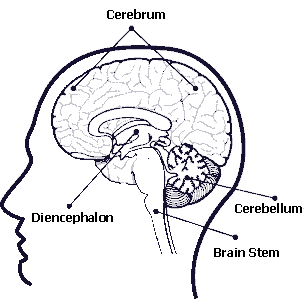
Figure 1: Regions of the Brain ( in the picture )
Many split-brain studies confirm that the right brain is superior at
assembling pieces of the world into a coherent picture.7 When we lack a
higher-level perception, the world will seem like a disconnected maze of in-
dividual experiences; the brain does not assemble three individual lines into
a triangle. We only see a ‘triangle’ when we change our viewpoint. To some

extent, this evidences a ‘higher-dimensional’ view of the subject. Whereas
the left brain has a ‘linear perspective’ in that it sees three individual one-
dimensional objects i.e. lines; the right brain, on the other hand, sees a
whole two-dimensional object i.e. a triangle.
The right side seems to be specialized for the large elements, the over-
all shapes of objects and the word shape. The left side handles the small,
precise links that carry the smaller, more precise meanings and movements.
It’s this specialization that contributes to one side being good for the analy-
sis of small features versus the holistic vision of the other side. The left
hemisphere is more focused on details and the right hemisphere is better at
perceiving overall patterns. This also goes for language processing.
People with right hemisphere damage can always understand the literal
meaning of a request, but they cannot always judge what the request means
in context (in other words, the ‘other dimensions’ of the subject). The use of
metaphor involves the right hemisphere. Metaphors, like indirect language,
sarcasm or irony, convey a significance that is different from the literal
meaning. Many right brain damaged patients also seem to have difficulty
in identifying the gist of passages. In order to do this, we need to be able
to see things as a whole.8 This has also been alluded to in the metaphysical
literature. Charles Leadbeater says that the ‘causal’ [or higher dimensional]
consciousness deals with the essence of a thing, while the ‘lower mind’ [as-
sociated with the left brain] studies its details.9

Monday, February 20, 2012

Different Modes of Thinking


The term ‘left brain’ used in this book includes both the higher (i.e. the
neocortex) and lower (for example, the amygdala) brain structures on the
left side of the brain. Similarly, the ‘right brain’ includes both the higher and
lower brain structures on the right side of the brain. According to Bernice

McCarthy, the two brains control two different ‘modes’ of thinking or cog-
nitive styles. Each of us prefers one mode over the other. While the left
brain is logical, sequential, rational, analytical and looks at parts; the right
brain activities appear random, intuitive, holistic, synthesizing and looks at
wholes.4 The left brain processes information from parts to whole; the right
brain however, processes from the whole to parts.


Sunday, February 19, 2012

Split-brain vs. Normal People


Split-brain studies imply but do not prove that ordinary people have two
minds. However, there is abundant scientific evidence that demonstrates

jay alfred | brains and realities
the relevance of split-brain findings for ordinary people with intact brains.
In split-brain patients the left brain uses different strategies from the right
brain.
Scientists have found that ordinary people have the same differences in
cognitive abilities between sides as split-brain patients. If an ordinary per-
son is seated in front of a screen and asked to look forward and an object is
flashed very briefly to his right side (i.e. his left brain), he will respond faster
and more accurately if the task involves language. If you flash a spatial task,
for example, asking the subject to identify if a dot is within a circle, he will
perform better when flashed on his left side (or to the right brain).
Ordinary people are also shown to be better at seeing the overall picture
if an image is flashed to the right brain. These studies and others involving
hearing through the left and right ears have been repeated many hundreds
of times in ordinary people, and the findings are consistently similar to
those in split-brain patients. The findings mean that the cognitive abilities
of the left and right brains of split-brain patients are similar to those of or-
dinary people.
PET scans show that even when normal people (with intact brains) talk,
the blood-flow pattern changes in their brains, and there’s more activity
in the left brain than in the right. When they imagine space, the pattern
reverses. One study on occupational preferences in cognitive styles showed
that those who declared English as a major had a greater blood flow in the
left brain (the verbal brain); whereas those who majored in architecture had
a correspondingly higher level in the right brain.1

When all the evidence is sifted and weighed, we are reminded
that our ‘ordinary’ minds are more similar to split-brain minds
than some neuroscientists would like us to believe.
Dr Frederic Schiffer 2
Despite myriad exceptions, the bulk of split-brain research has
revealed an enormous degree of lateralisation, or specialization
in each hemisphere.
Michael Gazzaniga 3

Right vs. Left Brain


Our brain, like many other parts of our anatomy, is made up of two halves,
a left brain and a right brain. They are connected to each other by a thick
cable of nerves at the base of each brain, called the corpus callosum. It is
analogous to a cable or network connection between two incredibly fast
and immensely powerful computers, each running a different program to
process basically the same input. When Roger Sperry severed the corpus
callosum in the sixties, which connected the left and right brains, he was
stunned by the fact that his ‘split-brain’ patients behaved as if they had two
minds and two persons in one body!
He found that the patient could name an object but could not explain
what it was used for when the object was shown only to the right eye (the
left ‘verbal’ brain processes data from the right visual field). When shown
to the left eye (the right ‘non-verbal’ brain processes data from the left
visual field), the patient could explain and demonstrate its use, but could
not name it. Roger Sperry received the 1981 Nobel Prize for his work in this
area. It appears that when a normal person names an object and explains
its purpose, both halves or hemispheres of the brain, which are connected
by the corpus callosum, participate in this final conclusion.