According to Ornstein, from the early studies of the split-brain through
recent research on the whole competently functioning brain, the scientific
understanding has become increasingly certain of the right brain’s role in
seeing the large view. Seeing the large organisation is a specialization of
the right brain. 5 More specifically, Newberg and d’ Aquili believe that the
right parietal lobe is involved in a holistic (top-down) approach to things
whereas the left parietal lobe is involved in a more reductionist and analytic
(bottom-up) process.6
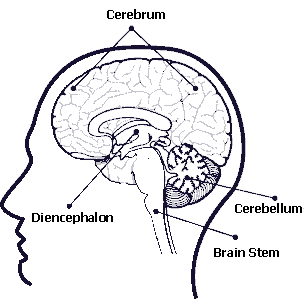
Figure 1: Regions of the Brain ( in the picture )
Many split-brain studies confirm that the right brain is superior at
assembling pieces of the world into a coherent picture.7 When we lack a
higher-level perception, the world will seem like a disconnected maze of in-
dividual experiences; the brain does not assemble three individual lines into
a triangle. We only see a ‘triangle’ when we change our viewpoint. To some
extent, this evidences a ‘higher-dimensional’ view of the subject. Whereas
the left brain has a ‘linear perspective’ in that it sees three individual one-
dimensional objects i.e. lines; the right brain, on the other hand, sees a
whole two-dimensional object i.e. a triangle.
The right side seems to be specialized for the large elements, the over-
all shapes of objects and the word shape. The left side handles the small,
precise links that carry the smaller, more precise meanings and movements.
It’s this specialization that contributes to one side being good for the analy-
sis of small features versus the holistic vision of the other side. The left
hemisphere is more focused on details and the right hemisphere is better at
perceiving overall patterns. This also goes for language processing.
People with right hemisphere damage can always understand the literal
meaning of a request, but they cannot always judge what the request means
in context (in other words, the ‘other dimensions’ of the subject). The use of
metaphor involves the right hemisphere. Metaphors, like indirect language,
sarcasm or irony, convey a significance that is different from the literal
meaning. Many right brain damaged patients also seem to have difficulty
in identifying the gist of passages. In order to do this, we need to be able
to see things as a whole.8 This has also been alluded to in the metaphysical
literature. Charles Leadbeater says that the ‘causal’ [or higher dimensional]
consciousness deals with the essence of a thing, while the ‘lower mind’ [as-
sociated with the left brain] studies its details.9

No comments:
Post a Comment